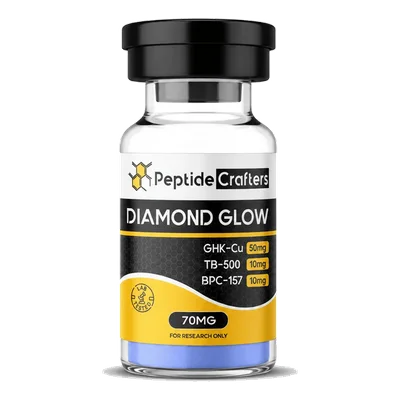
GLOW is a vendor trade name for a 70mg research peptide blend of GHK-Cu 50mg, BPC-157 10mg and TB-500 10mg in a single vial. It isn't an approved drug, its label varies by vendor, and we found no published study of the three-peptide combination; on October 21, 2026, GLOW listed at a median of $1.60 per mg across 63 in-stock vendors.
Notice: Research peptides are sold for in-vitro laboratory research only. They are not FDA-approved, not for human or animal consumption, and this page is not medical advice. It contains no dosing or use guidance.
Facts checked October 29, 2026, unless another date is shown.
GLOW ingredients
GHK-Cu makes up five-sevenths of a standard GLOW vial by labeled weight. The other two components are the same pair sold as the popular BPC-157/TB-500 blend.
| Component | Amount | Share of vial | Our explainer |
|---|---|---|---|
| GHK-Cu (copper tripeptide) | 50 mg | 71% | What is GHK-Cu? |
| BPC-157 | 10 mg | 14% | What is BPC-157? |
| TB-500 | 10 mg | 14% | What is TB-500? |
| Total | 70 mg |
Sources: Ascension's GLOW page, listed as "GHK-CU 50mg + BPC-157 10mg + TB-500 10mg (GLOW 70mg)", PSPeptides' GLOW page and Licensed Peptides' GLOW blend page.
Variants that share the name
"GLOW" isn't regulated or trademarked across these sellers, so the same word covers different vials:
- Different ratios. NextGenPeps has listed a 50mg GLOW of GHK-Cu 40mg, BPC-157 5mg and TB-500 5mg, according to our GLOW and KLOW vendor comparison. Some vendors in our GLOW price index list 45mg, 73mg, 90mg or 140mg vials.
- Non-vial products. Licensed Peptides' store also lists a "Glow" capsule product with very different amounts (GHK-Cu 2mg, BPC 500mcg, TB 500mcg), which is not the 70mg blend.
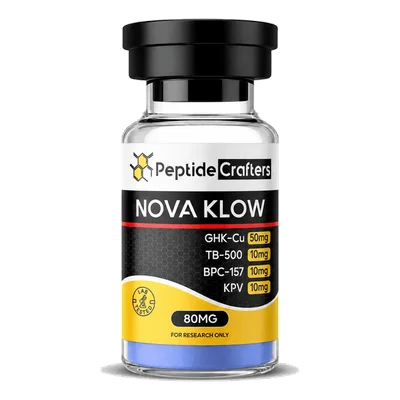
- KLOW. Adding 10mg of KPV makes KLOW, an 80mg vial.
Because of this, compare GLOW by the component amounts printed on the certificate, not by the name.
GLOW vs copper peptide skin care
GHK-Cu is also a cosmetic ingredient, often labeled "copper tripeptide-1," which is why GLOW gets confused with skin-care products. They're regulated differently. FDA says cosmetics "do not need FDA premarket approval" except color additives (FDA), and whether a product is a cosmetic or a drug depends on its intended use. A lyophilized research vial that also contains BPC-157 and TB-500 isn't a cosmetic, and FDA's 2026 warning letters treat research-labeled peptides as unapproved new drugs when a seller's marketing shows they're meant for people.
What research exists
There's published research on each ingredient, but we found none on the blend. A web search on October 29, 2026 for studies of the GHK-Cu, BPC-157 and TB-500 combination returned vendor and marketing pages, not peer-reviewed papers.
- GHK-Cu: a 2018 review, led by an author listed with a skin-care company, groups the evidence into cell studies, rodent and rabbit wound models, small cosmetic studies of creams, and computational gene-expression analyses. FDA notes limited human data on safety for injectable forms.
- BPC-157: studies are "predominantly limited to small animal models," according to a 2019 review in Cell and Tissue Research.
- TB-500: FDA's compounding safety page says it "has not identified any human exposure data" on drug products containing the fragment.
Evidence for one peptide on its own doesn't transfer to a mixture, where stability and interactions in the vial are untested in the published record.
Regulatory status (October 2026)
None of GLOW's components is an approved drug. FDA's July 2026 compounding advisory committee voted to recommend BPC-157 and TB-500 for pharmacy compounding; those votes are non-binding and FDA hadn't acted on them as of October 21, 2026. FDA is still evaluating non-injectable GHK-Cu. TB-500 is prohibited at all times under S2.3 of WADA's 2026 Prohibited List. More: FDA peptide regulation in 2026 and are peptides legal?
GLOW prices in October 2026
Our GLOW price index, checked October 21, 2026, found 63 vendors with GLOW in stock, a median of $1.60 per mg (about $112 per 70mg vial) and a range of $0.46 to $3.71 per mg. Rated vendors, rechecked on their own sites October 29, 2026:
| Vendor | Size | Price | $/mg | Our code | After code |
|---|---|---|---|---|---|
| PSPeptides | 70 mg | $84.99 | $1.21 | CHECKED (10%) | $76.49 |
| Alpha Pro Peptides | 70 mg | $99.99 (Oct 21) | $1.43 | None | - |
| Ascension Peptides | 70 mg | $110 (was $174.99) | $1.57 | AFFILIATE50OFF (50%, first order) | $55.00 |
| Blank Peptides | 70 mg | $125 (Oct 21) | $1.79 | CHECKED (10%) | $112.50 |
| NextGenPeps | 70 mg | $134 (Oct 21) | $1.91 | None | - |
| American Peptides | 70 mg | $150 (Oct 21) | $2.14 | None | - |
| Licensed Peptides | 70 mg | $189.99 (was $211.10) | $2.71 | Affiliate5 (5%) | $180.49 |
Single-vial prices before shipping, including any displayed sale. Rows marked Oct 21 are from our weekly index (Blank Peptides shows prices only to signed-in members). Peptide Plugs, which sells KLOW, had no GLOW product in its store on October 29, 2026. "After code" is arithmetic, not a checkout quote; we couldn't confirm whether codes stack with sale prices. All current codes: peptide coupon codes.
Disclosure: PeptideChecked has affiliate relationships with several vendors above, including PSPeptides, Blank Peptides, Ascension Peptides and Licensed Peptides. We may earn a commission if you buy through our links or use our codes. That doesn't change any rating, which comes only from our published method.
What a GLOW certificate should show
- All three peptides identified and measured, not one overall purity figure. PSPeptides' GLOW certificate, for example, reports GHK-Cu, BPC-157 and TB-500 amounts separately.
- A total close to 70mg. Our vendor comparison found one GLOW certificate adding up to 75.78mg against a 70mg label.
- A named lab and a batch that matches your vial.
See how to read a peptide COA and peptide purity vs net content.
Bottom line
GLOW is a shared label for a 70mg research blend that's mostly GHK-Cu, with BPC-157 and TB-500 making up the rest. No component is approved, the combination hasn't been studied in published work we could find, and per-mg prices vary about eightfold. Check the blend-specific certificate first; the GLOW and KLOW vendor comparison covers each vendor's paperwork.