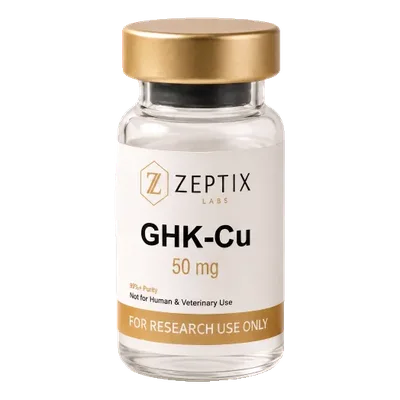
GHK-Cu is a small copper-binding peptide (glycyl-L-histidyl-L-lysine plus copper) found naturally in human plasma and sold in two very different forms: as a skin-care ingredient and as lyophilized "research" vials. No GHK-Cu drug is FDA-approved. As of October 21, 2026, FDA is evaluating non-injectable GHK-Cu for pharmacy compounding and plans an advisory meeting on it by the end of February 2027, while flagging safety concerns about injectable forms.
Notice: Research peptides are sold for in-vitro laboratory research only. They are not FDA-approved, not for human or animal consumption, and this page is not medical advice. It contains no dosing or use guidance.
What GHK-Cu is
GHK is a three-amino-acid peptide: glycine, histidine and lysine. It binds copper(II) ions tightly, and the copper complex is what's sold as GHK-Cu. A 2018 review in the International Journal of Molecular Sciences says GHK was first identified in human plasma in 1973 and that its levels are highest in young people and fall with age.
That review is the most-cited overview of GHK-Cu, and it's worth knowing who wrote it. Lead author Loren Pickart is listed with R&D Skin Biology, a company. The paper declares no conflicts, but it argues for cosmetic and therapeutic uses of GHK-Cu, and readers should weigh that affiliation.
Cosmetic GHK-Cu vs research vials
The same molecule shows up in very different products. The regulatory treatment depends on the product, not the molecule.
| Cosmetic GHK-Cu | Research-labeled GHK-Cu vials | |
|---|---|---|
| Typical form | Creams, serums and hair products, often labeled "copper tripeptide-1" (ingredient listing) | Lyophilized powder in a sealed vial, commonly 50 to 100 mg |
| FDA premarket approval | Not required for cosmetics | Not approved; sold outside any drug approval |
| What decides its status | Intended use: cosmetic claims only | FDA judges intended use from the seller's whole website |
| Evidence base | Small cosmetic studies, mostly of creams | No approved injectable product; FDA notes limited human data |
Cosmetics. FDA says "cosmetic products and ingredients do not need FDA premarket approval," except color additives (FDA). Whether something is a cosmetic or a drug is "determined by a product's intended use." A product claimed to affect "the structure or any function of the body" can be a drug even when it looks like skin care (FDA).
Research vials. These are a separate market. FDA's 2026 warning letters treat "research use only" peptides as unapproved new drugs when a seller's marketing shows they're meant for people (FDA peptide regulation in 2026).
What the evidence covers
According to the 2018 review, GHK-Cu research falls into four groups:
- Cell culture studies.
- Animal studies, mostly rodent and rabbit wound-healing models.
- Small cosmetic studies of topical products measuring outcomes like wrinkles and skin thickness. Several are conference abstracts or pilot studies.
- Gene-expression database analyses (the Connectivity Map), which are computational and haven't been confirmed biologically.
There's no large randomized trial of GHK-Cu as a drug. FDA's own summary says "there are limited data in humans to inform safety-related considerations" for injectable GHK-Cu (FDA).
Is GHK-Cu FDA approved? Regulatory status (October 2026)
FDA treats GHK-Cu differently depending on the route of administration.
- Not approved as a drug by any route.
- Non-injectable GHK-Cu: under evaluation. FDA's 503A categories list, updated May 14, 2026, places "GHK-Cu (except for injectable routes of administration)" in Category 1, bulk substances under evaluation for pharmacy compounding.
- Injectable GHK-Cu: safety concerns noted. FDA's compounding safety page (current as of April 22, 2026) lists "GHK-Cu (for injectable routes of administration)" among Category 2 nominations "withdrawn by the nominators." It says compounded injectables "may pose risk for immunogenicity" due to possible aggregation and peptide-related impurities.
- Advisory meeting coming. GHK-Cu wasn't among the seven peptides reviewed in July 2026. FDA's advisory committee page says it will hold a meeting "before the end of February 2027" on LL-37, GHK-Cu, dihexa acetate, Melanotan II and PEG-MGF. As of October 21, 2026, we hadn't seen a date published.
- Not federally controlled. We found no DEA scheduling action for GHK-Cu.
Compounding decisions apply only to licensed pharmacies working from prescriptions. They don't change the status of research-labeled vials. Background: are peptides legal? and our regulatory news log.
WADA
GHK-Cu isn't named on the 2026 Prohibited List (list text). S0 prohibits substances not covered elsewhere that have "no current approval by any governmental regulatory health authority for human therapeutic use." WADA's 2027 explanatory note says peptides are now named as S0 examples and advises "utmost caution" with unlisted peptides. Athletes should ask their anti-doping organization.
Research-grade vials: what the market looks like
As of October 21, 2026, 85 vendors in our GHK-Cu price index had it in stock, with a median of $0.65 per mg, far lower per mg than most research peptides. The lowest per-mg listings were 100 mg vials:
| Vendor | Listing | Price | $/mg |
|---|---|---|---|
| Transition Biotech | GHK-Cu (Copper) 100mg | $29.99 | $0.30 |
| Zeptix Labs | GHK-Cu 100mg (per-vial price; site runs buy-1-get-1) | $29.99 | $0.30 |
| Peptide Plugs | GHK-Cu 100mg | $35.00 | $0.35 |
Prices are as listed on vendors' sites on October 21, 2026 and change often. GHK-Cu is also a component of the GLOW and KLOW blends (vendor comparison). The related copper peptide AHK-Cu has its own price page. For GHK-Cu vendors compared on documentation, see best GHK-Cu vendors.
How to check a GHK-Cu COA
- Identity by mass spectrometry, confirming the GHK peptide and not only a purity percentage.
- Copper content. Look for whether the certificate addresses the copper complex, since GHK and GHK-Cu aren't the same product.
- Measured content vs the label. Large 100 mg vials make underfill harder to spot (purity vs net content).
- Lot number, test date and a named lab you can look up.
- Endotoxin data if claimed (endotoxin testing).
More: how to read a peptide COA and the COA checklist.
Bottom line
GHK-Cu is a real, naturally occurring copper peptide with a long cosmetic history and mostly cell, animal and small cosmetic studies behind it. Skin care containing it doesn't need FDA approval. Injectable GHK-Cu is a different matter: FDA has flagged immunogenicity concerns and limited human data, and its compounding review won't reach an advisory committee until early 2027 at the latest. Research vials sit outside both systems.
Sources are linked inline and were checked October 21, 2026. We'll update this page after FDA's GHK-Cu advisory meeting.