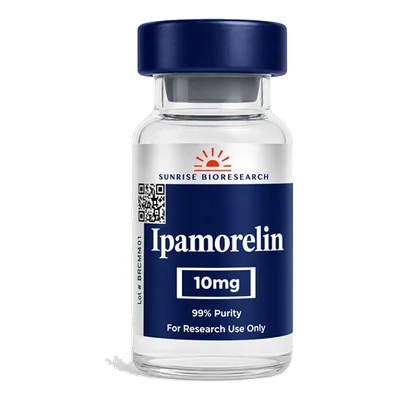
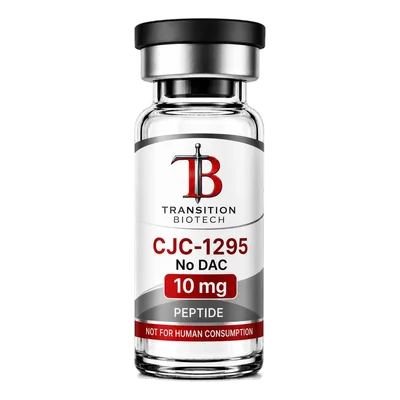
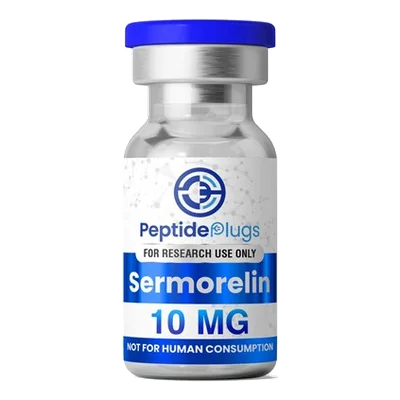
CJC-1295 vs sermorelin: both are GHRH analogs based on the first 29 amino acids of growth hormone-releasing hormone, but sermorelin is the unmodified fragment with a half-life of minutes, while CJC-1295 is a modified, albumin-binding version with a half-life measured in days. Sermorelin was FDA-approved as Geref until its 2008 discontinuation; CJC-1295 was never approved. Both are on WADA's prohibited list.
Research-use notice: This page summarizes published research and regulatory documents for general education. It isn't medical advice and contains no dosing guidance. Neither compound is currently sold as an approved drug in the US, and research-chemical products aren't regulated for quality. Last reviewed October 20, 2026.
Side by side
| CJC-1295 (with DAC) | Sermorelin | |
|---|---|---|
| What it is | Modified GRF(1-29) with an albumin-binding "Drug Affinity Complex", developed by ConjuChem | GRF(1-29) NH2, the first 29 amino acids of human GHRH |
| Receptor | GHRH receptor (pituitary) | GHRH receptor (pituitary) |
| Size | 29 amino acids plus DAC linker | 29 amino acids |
| Half-life | Estimated 5.8 to 8.1 days (Teichman 2006) | Minutes |
| Human evidence | Small Phase 1 study; Phase 2 halted in 2006 | Approved diagnostic and pediatric uses (Geref) |
| FDA status | Never approved; "nominated but withdrawn" table | Formerly approved; discontinued 2008 |
| WADA 2026 | Named, S2.2.4 | Named, S2.2.4 |
| Our price index | CJC-1295 prices | Sermorelin prices |
How they work
Growth hormone-releasing hormone is a 44-amino-acid peptide that signals the pituitary to release growth hormone (GH). Its first 29 amino acids are the shortest fully active fragment, and that fragment is sermorelin.
- Sermorelin binds the GHRH receptor and stimulates pituitary GH release. Enzymes, including DPP-4, break it down quickly, so its half-life is in the range of minutes.
- CJC-1295 keeps the same backbone with four substitutions (D-Ala2, Gln8, Ala15, Leu27) that resist DPP-4 cleavage and improve stability. It also carries a lysine-maleimidopropionamide linker, the Drug Affinity Complex (DAC), which binds covalently to serum albumin and greatly extends its time in circulation.
Both act on the same receptor. The practical difference in the research is duration of action.
What the research found
CJC-1295. The main human study is Teichman et al. (2006) in healthy adults (J Clin Endocrinol Metab 2006;91:799-805):
- A single injection raised mean GH levels 2- to 10-fold for 6 days or more.
- IGF-I rose 1.5- to 3-fold for 9 to 11 days.
- The estimated half-life was 5.8 to 8.1 days.
- After repeated administration, IGF-I stayed elevated for up to 28 days.
ConjuChem then began a Phase 2 trial in HIV-associated visceral obesity, enrolling 192 people. It halted the trial on July 17, 2006 after a participant died at a site in Argentina, and development didn't proceed (aidsmap; FDAnews).
Sermorelin. Sermorelin's human evidence is tied to its approved uses as Geref: testing the pituitary's capacity to secrete GH, and treating idiopathic GH deficiency in children with growth failure (Federal Register, 2013).
Regulatory status
- Sermorelin: FDA approved Geref (EMD Serono) under NDA 19-863 on December 28, 1990 for diagnostic use, and under NDA 20-443 on September 26, 1997 for idiopathic GH deficiency in children. The products were discontinued in 2008, and both NDAs were withdrawn effective June 18, 2009. In 2013, FDA determined that Geref "was not withdrawn for reasons of safety or effectiveness" (78 FR 14095). Sermorelin isn't on FDA's significant-safety-risks page.
- CJC-1295: never approved. It's in the "nominated but withdrawn" table on FDA's significant-safety-risks page (content current as of April 22, 2026), with FDA's note that it "has identified serious adverse events associated with CJC-1295 including increased heart rate" (FDA). Leaving Category 2 isn't an approval. CJC-1295 and sermorelin were not voted on at FDA's July 2026 Pharmacy Compounding Advisory Committee meeting (McDermott).
- FDA enforcement: FDA has repeatedly rejected "research use only" labels on peptides sold online, including in a March 2026 warning letter to Gram Peptides (FDA). See FDA peptide regulation in 2026 and are peptides legal?.
- WADA 2026: both are named under S2.2.4, growth hormone-releasing factors, which lists "growth hormone-releasing hormone (GHRH) and its analogues (e.g., CJC-1293, CJC-1295, sermorelin, and tesamorelin)." They're prohibited at all times (WADA).
Naming confusion: what research buyers should check
This is the comparison where labels mislead most.
- "CJC-1295 with DAC" is the ConjuChem molecule studied in Teichman 2006.
- "CJC-1295 without DAC" is really Modified GRF(1-29), often sold as "Mod GRF 1-29": the four-substitution GRF(1-29) without the albumin-binding DAC. Strictly, it isn't CJC-1295, and there's essentially no published human trial of it as sold. The 2006 half-life data don't apply to it.
- Sermorelin and Mod GRF 1-29 are both "GRF 1-29". Sermorelin is the unmodified sequence; Mod GRF 1-29 has the four substitutions.
- Mass spec is the only way to tell them apart. All three have different molecular weights. Check the mass on the COA against the published molecular weight for the exact molecule on the label, not just "CJC-1295".
- Blends. "CJC/ipamorelin" products should have a COA that identifies both components and states which CJC is included.
Our COA guide explains how to read a mass spec result.
Prices and vendors
- Price history: CJC-1295 price index and sermorelin price index
- Vendor rankings with COA notes: best CJC-1295 vendors and best sermorelin vendors
- Compare per-milligram prices across vendors: peptide price comparison tool
Bottom line
Sermorelin and CJC-1295 act on the same receptor, but CJC-1295 was engineered to last days instead of minutes. Sermorelin has a regulatory history as an approved drug that FDA says wasn't withdrawn for safety reasons; CJC-1295 was never approved and its development stopped in 2006. For research buyers, the biggest risk is the name: "CJC-1295 without DAC" is a different molecule, and only a mass spec result shows what's in the vial.
Sources are linked inline. We'll update this page as regulatory status changes.