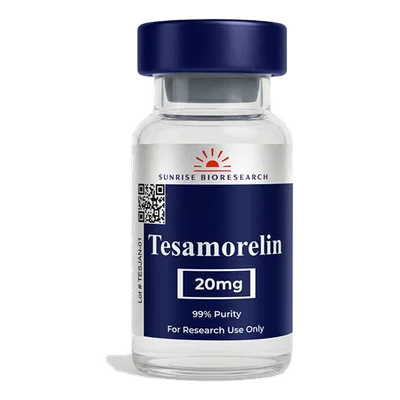
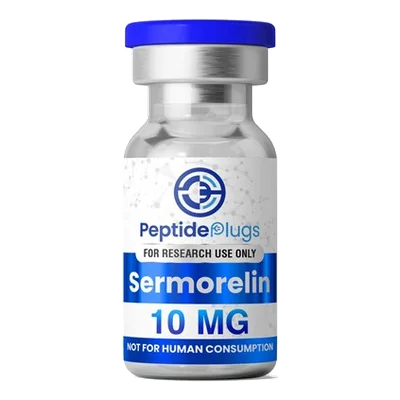
Tesamorelin vs sermorelin: both are analogs of growth hormone-releasing hormone (GHRH), but tesamorelin is the full 44-amino-acid hormone with a stabilizing modification, approved today as Egrifta, while sermorelin is the unmodified 29-amino-acid fragment that was approved as Geref until it was discontinued in 2008. They act on the same receptor. The differences are size, stability, the evidence behind each and what "research" vials under each name actually contain.
Research-use notice: This page summarizes published research and regulatory documents for general education. It isn't medical advice and contains no dosing guidance. Products sold as research chemicals under either name are unapproved and aren't regulated for quality. Last reviewed October 21, 2026.
Side by side
| Tesamorelin | Sermorelin | |
|---|---|---|
| What it is | Modified full-length GHRH (Theratechnologies, Egrifta) | GHRH(1-29), the shortest fully active fragment (EMD Serono, Geref) |
| Receptor | GHRH receptor (pituitary) | GHRH receptor (pituitary) |
| Size | 44 amino acids plus a trans-3-hexenoyl group | 29 amino acids, unmodified |
| Stability | Modification resists DPP-4 cleavage | Broken down quickly; half-life of minutes |
| Human evidence | Phase 3 randomized trials in HIV-associated abdominal fat | Approved diagnostic and pediatric uses (Geref) |
| FDA status | Approved since 2010; current form Egrifta WR | Approved 1990/1997, discontinued 2008, not for safety reasons |
| WADA 2026 | Named, S2.2.4 | Named, S2.2.4 |
| Our price index | Tesamorelin prices | Sermorelin prices |
How they work
Growth hormone-releasing hormone is a 44-amino-acid peptide that signals the pituitary to release growth hormone (GH). Its first 29 amino acids are the shortest fully active fragment.
- Sermorelin is that 29-amino-acid fragment, unchanged. It binds the GHRH receptor and stimulates GH release, but enzymes, including DPP-4, break it down within minutes.
- Tesamorelin keeps all 44 amino acids and adds a trans-3-hexenoyl group to the first one (tyrosine). That change resists DPP-4 breakdown, which is what made a once-daily approved product practical.
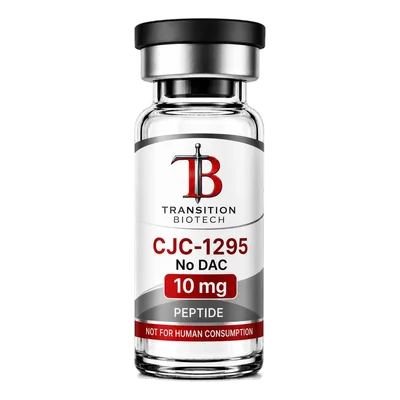
A third GHRH analog, CJC-1295, takes a different route to stability (amino-acid substitutions plus an albumin-binding linker); it's compared in CJC-1295 vs sermorelin.
What the research found
Tesamorelin. The pivotal phase 3 trial (Falutz et al., N Engl J Med 2007) enrolled 412 people with HIV and excess abdominal fat for 26 weeks (NATAP summary):
| Outcome at 26 weeks | Tesamorelin | Placebo |
|---|---|---|
| Visceral adipose tissue | -15.2% | +5.0% |
| IGF-I | +81% | -5% |
| Stopped due to adverse events | 12.1% | 2.9% |
| Developed IgG antibodies | 48.6% | 2.7% |
These results apply to people with HIV-associated lipodystrophy, the population studied; the prescribing information is the authoritative source on warnings.
Sermorelin. Its human evidence is tied to its approved uses as Geref: testing the pituitary's capacity to secrete GH, and treating idiopathic GH deficiency in children with growth failure (Federal Register, 2013). We found no modern randomized trials of sermorelin comparable to tesamorelin's phase 3 program.
Regulatory status
- Tesamorelin: FDA approved Egrifta on November 10, 2010 for excess abdominal fat in HIV-infected patients with lipodystrophy. Egrifta SV was approved in November 2018 (GlobeNewswire) and Egrifta WR on March 25, 2025 (Theratechnologies via SEC). FDA's August 24, 2026 warning letter to NuScience Peptides named tesamorelin among the products it sold (FDA).
- Sermorelin: FDA approved Geref under NDA 19-863 on December 28, 1990 (diagnostic use) and NDA 20-443 on September 26, 1997 (pediatric GH deficiency). The products were discontinued in 2008 and the NDAs withdrawn effective June 18, 2009; in 2013 FDA determined Geref "was not withdrawn for reasons of safety or effectiveness" (78 FR 14095). Sermorelin isn't on FDA's significant-safety-risks page and wasn't voted on at the July 2026 compounding advisory meeting (McDermott).
- "Research" sellers: FDA has repeatedly rejected "research use only" labels on peptides sold online. See FDA peptide regulation in 2026.
- WADA 2026: S2.2.4 lists "growth hormone-releasing hormone (GHRH) and its analogues (e.g., CJC-1293, CJC-1295, sermorelin, and tesamorelin)," prohibited at all times (WADA).
What research buyers should check
- Identity by mass spec. The two differ by 15 amino acids and a modification, so their molecular weights are far apart. A COA's mass spectrometry result should match the published weight of the molecule on the label; an HPLC purity number alone can't tell them apart.
- Substitution risk. Sermorelin or unmodified GHRH(1-44) is cheaper to make than tesamorelin. A "tesamorelin" vial priced far below the market is worth a closer look at the mass result.
- Sermorelin vs Mod GRF 1-29. Both are "GRF 1-29"; Mod GRF 1-29 has four substitutions and a different mass. Check which one the COA identifies.
- Lot match. The COA's lot number should match the vial you receive, from a lab you can verify.
Our COA guide explains each test.
Prices and vendors
- Price history: tesamorelin price index and sermorelin price index
- Vendor rankings with COA notes: best tesamorelin vendors and best sermorelin vendors
- Related comparisons: tesamorelin vs ipamorelin, CJC-1295 vs sermorelin, ipamorelin vs sermorelin
Bottom line
Tesamorelin and sermorelin hit the same receptor, but tesamorelin is a stabilized full-length GHRH with phase 3 data and a current FDA approval for one population, while sermorelin is the short, fast-degrading fragment whose approved products were discontinued in 2008. Both are banned in sport, and research material under either name needs a mass spec identity check.
Sources are linked inline. We'll update this page as regulatory status changes.