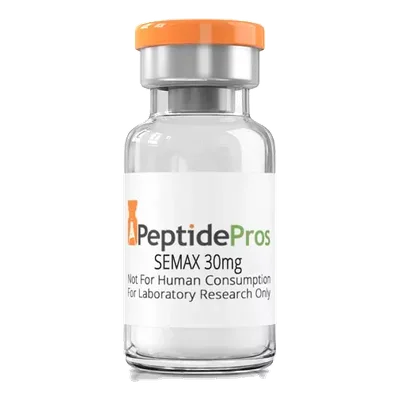
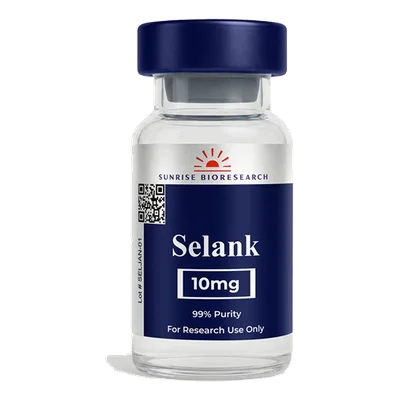
Semax vs selank: both are short Russian peptides from the same institute and share the same Pro-Gly-Pro tail, but semax is an ACTH(4-10) analog studied mainly in stroke and cognition, while selank is a tuftsin analog studied mainly as an anxiolytic. Neither is FDA-approved. In July 2026, FDA's compounding advisers recommended semax for the 503A bulks list; selank wasn't on the agenda.
Research-use notice: This page summarizes published research and regulatory documents for general education. It isn't medical advice and contains no dosing guidance. Semax and selank aren't approved drugs in the US, and products sold as research chemicals aren't the Russian-registered medicines. Last reviewed October 20, 2026.
Side by side
| Semax | Selank | |
|---|---|---|
| What it is | Synthetic heptapeptide, analog of ACTH(4-10) | Synthetic heptapeptide, analog of tuftsin |
| Size and sequence | 7 amino acids: Met-Glu-His-Phe-Pro-Gly-Pro | 7 amino acids: Thr-Lys-Pro-Arg-Pro-Gly-Pro |
| Proposed mechanism | BDNF/TrkB in animal models; serotonergic and dopaminergic effects | Anxiolytic and immunomodulatory; BDNF in rat studies |
| Human evidence | Small trials, almost all in Russia | Small trials, almost all in Russia |
| FDA status | Not approved; PCAC recommended for 503A list (July 2026) | Not approved; not voted on |
| WADA 2026 | Not named | Not named |
| Our price index | Semax prices | Selank prices |
How they work
Both were developed at the Institute of Molecular Genetics of the Russian Academy of Sciences. Each takes a short natural peptide fragment and adds a Pro-Gly-Pro (PGP) tail, which is meant to slow breakdown (Wikipedia: Semax; Wikipedia: Selank).
- Semax starts from ACTH(4-7), the Met-Glu-His-Phe stretch of adrenocorticotropic hormone. Animal studies report increases in hippocampal BDNF and its receptor TrkB, effects on serotonergic and dopaminergic systems, and antagonism of α-MSH at the MC4 and MC5 receptors.
- Selank starts from tuftsin (Thr-Lys-Pro-Arg), a tetrapeptide derived from immunoglobulin G. It has been studied for anxiolytic effects and for immune signaling.
There's one notable overlap: both inhibit enzymes that break down enkephalins, according to a 2001 study (Kost et al., PMID 11443939).
What the research found
Most of the literature on both compounds comes from Russian groups and consists of animal studies and small clinical trials. Per secondary summaries, there were no published clinical trials of semax outside Russia or other post-Soviet states as of November 2023 (Wikipedia).
Semax
- Ischemic stroke rehabilitation: Gusev et al. (2018) studied 110 patients and reported an association with BDNF levels (summary).
- Brain imaging: Lebedeva et al. (2018) ran a 24-person fMRI study of the default mode network (summary).
- Other research areas include cognition and attention and optic nerve disease.
Selank
- Anxiety: Zozulia et al. (2008) compared selank with standard anxiolytics in generalized anxiety disorder and neurasthenia (PMID 18454096).
- Immune effects: Uchakina et al. (2008) reported effects on IL-6 and T-helper cytokines (PMID 18577961).
- BDNF: Inozemtseva et al. (2008) reported raised BDNF in rat hippocampus (PMID 18841804).
None of these studies is large, and few have been replicated by independent groups. Animal findings don't establish effects in people.
Regulatory status
- Russia: semax is a registered drug and appears on Russia's List of Vital and Essential Drugs, with listed uses including stroke, transient ischemic attack and cognitive disorders (Wikipedia). Selank is reportedly registered in Russia as an anxiolytic.
- FDA: neither is approved. Both are in the "nominated but withdrawn" table on FDA's page of bulk substances that may present significant safety risks (content current as of April 22, 2026). FDA's notes say it "has no, or limited, safety-related information for proposed routes of administration" for semax and "lacks important information regarding any safety issues raised by selank acetate administered to humans" (FDA). Leaving that list isn't an approval.
- PCAC: on July 24, 2026, FDA's Pharmacy Compounding Advisory Committee voted 8-5 with one abstention to recommend semax for the 503A bulks list, for uses FDA reviewed including cerebral ischemia, migraine and trigeminal neuralgia (McDermott; RAPS). PCAC votes are non-binding, and a substance joins the list only through rulemaking (Holland & Knight). Selank wasn't on the July 2026 agenda. See FDA peptide regulation in 2026.
- WADA 2026: neither is named on the Prohibited List, and we found no WADA statement on either compound. Athletes should check with their anti-doping organization.
For the broader legal picture, see are peptides legal?.
What research buyers should check
- Identity by mass spec. Semax and selank have different sequences and different masses. The COA's mass spectrometry result should match the published molecular weight for the compound on the label (PubChem lists both).
- Modified versions. "N-Acetyl Semax", "NA-Semax-Amidate" and "N-Acetyl Selank Amidate" are vendor-modified derivatives. They aren't the Russian-registered molecules, have essentially no published human data, and their COAs should show the modified mass.
- Finished-product testing. Many vendors sell these as nasal-spray solutions. Check whether the COA covers the finished solution or only the raw powder.
- Batch match. The lot number on the COA should match the product you're buying.
Our COA guide explains each test.
Prices and vendors
- Price history: semax price index and selank price index
- Vendor rankings with COA notes: best semax vendors and best selank vendors
- Compare per-milligram prices across vendors: peptide price comparison tool
Bottom line
Semax and selank are closely related in origin and structure but were built on different parent peptides and studied for different purposes: semax for stroke and cognition, selank for anxiety and immune signaling. The evidence for both is thin and mostly Russian. In the US, semax has a non-binding PCAC recommendation while selank hasn't been reviewed, and neither is approved. For research buyers, confirming the exact molecule, including whether it's an acetylated or amidated variant, is the main check.
Sources are linked inline. Regulatory status is changing; we'll update this page as it does.