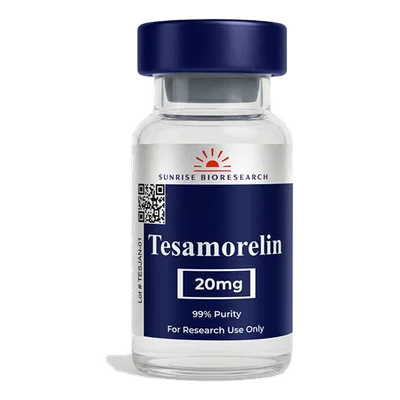
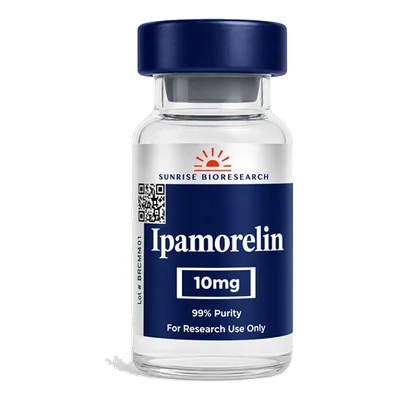
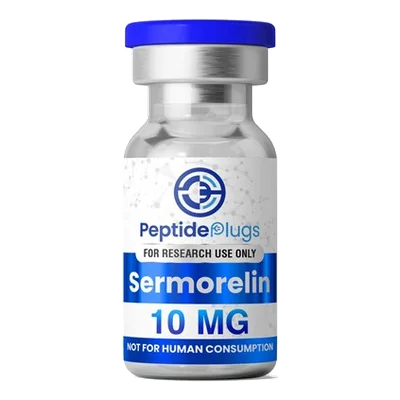
Ipamorelin vs sermorelin: both lead to growth hormone release, but ipamorelin is a small ghrelin-receptor agonist while sermorelin is a fragment of growth hormone-releasing hormone (GHRH) that acts on the GHRH receptor. Sermorelin was FDA-approved as Geref until 2008. Ipamorelin was never approved, failed to beat placebo in its only published Phase 2 trial, and is still on FDA's Category 2 list.
Research-use notice: This page summarizes published research and regulatory documents for general education. It isn't medical advice and contains no dosing guidance. Neither compound is currently sold as an approved drug in the US, and research-chemical products aren't regulated for quality. Last reviewed October 20, 2026.
Side by side
| Ipamorelin | Sermorelin | |
|---|---|---|
| What it is | Growth hormone secretagogue (ghrelin mimetic), discovered at Novo Nordisk | GRF(1-29) NH2, the first 29 amino acids of human GHRH |
| Receptor | Ghrelin receptor (GHS-R1a) | GHRH receptor |
| Size | 5 amino acids | 29 amino acids |
| Human evidence | Phase 2 postoperative ileus trial; no efficacy over placebo | Approved diagnostic and pediatric uses (Geref) |
| FDA status | Never approved; Category 2 (503B) | Formerly approved; discontinued 2008 |
| WADA 2026 | Named, S2.2.4 (GH secretagogues) | Named, S2.2.4 (GHRH analogues) |
| Our price index | Ipamorelin prices | Sermorelin prices |
How they work
The pituitary releases growth hormone (GH) in response to more than one signal, and these two compounds use different ones.
- Sermorelin is the shortest fully active fragment of GHRH, the hypothalamic hormone that tells the pituitary to release GH. It binds the GHRH receptor and has a half-life of minutes. (Its modified cousin, CJC-1295, is covered in CJC-1295 vs sermorelin.)
- Ipamorelin is a pentapeptide (Aib-His-D-2Nal-D-Phe-Lys-NH2) that activates the ghrelin receptor, GHS-R1a. That makes it a growth hormone secretagogue, in the same broad class as GHRP-2, GHRP-6 and the non-peptide ibutamoren.
Because they act through separate receptors, GHRH analogs and ghrelin-receptor agonists are often discussed together in the endocrinology literature. That's a physiology question, not evidence for any human use.
What the research found
Ipamorelin
- Selectivity: Raun et al. (1998) at Novo Nordisk described ipamorelin as "the first selective growth hormone secretagogue." In vitro it had an EC50 of 1.3 nmol/L and reached 85% of GHRP-6's maximum effect; in animals its potency was similar to GHRP-6. Unlike GHRP-2 and GHRP-6, it didn't raise ACTH or cortisol beyond levels seen with GHRH, even far above the amounts needed for GH release (Eur J Endocrinol 1998;139:552-561).
- Postoperative ileus: Helsinn Therapeutics later tested intravenous ipamorelin to speed recovery of gut function after bowel surgery. In the Phase 2 trial (NCT00672074; 117 patients, 2008-2009), median time to the first tolerated meal was 25.3 hours with ipamorelin vs 32.6 hours with placebo, which wasn't statistically significant (p=0.15). Adverse events occurred in 87.5% vs 94.8%. The authors described it as well tolerated, but it showed no efficacy over placebo and development for that use wasn't pursued (Beck et al., Int J Colorectal Dis 2014;29:1527-1534).
Sermorelin
Sermorelin's human evidence is tied to its approved uses as Geref: testing the pituitary's capacity to secrete GH, and treating idiopathic GH deficiency in children with growth failure (Federal Register, 2013).
Regulatory status
- Ipamorelin: never approved anywhere. On FDA's significant-safety-risks page (content current as of April 22, 2026), ipamorelin acetate is still in Category 2 for 503B, added September 29, 2023. FDA's note reads: "A study published in literature identified serious adverse events including death when ipamorelin was administered." It also appears in the separate "nominated but withdrawn" table for "certain other injectable routes" (FDA). A February 2026 HHS announcement was reported as including ipamorelin among peptides to move off Category 2 (Pharmacy Times), but FDA's April page still lists it. Ipamorelin wasn't on the July 2026 PCAC agenda.
- Sermorelin: FDA approved Geref (EMD Serono) on December 28, 1990 for diagnostic use and on September 26, 1997 for idiopathic GH deficiency in children. It was discontinued in 2008, both NDAs were withdrawn effective June 18, 2009, and FDA determined in 2013 that Geref "was not withdrawn for reasons of safety or effectiveness" (78 FR 14095). Sermorelin isn't on the significant-safety-risks page and wasn't voted on at the July 2026 PCAC meeting.
- FDA enforcement: FDA has rejected "research use only" disclaimers in 2026 warning letters to peptide sellers (FDA, Gram Peptides; Sheppard Mullin). See FDA peptide regulation in 2026 and are peptides legal?.
- WADA 2026: S2.2.4 names ipamorelin among "growth hormone secretagogues (GHS) and their mimetics" and sermorelin among GHRH analogues. Both are prohibited at all times (WADA).
What research buyers should check
- Identity by mass spec. Ipamorelin and sermorelin differ greatly in size, so a mass spectrometry result should easily distinguish them. Check the mass on the COA against the published molecular weight for the compound on the label.
- GHRP substitution. Look out for products that are actually another secretagogue, such as GHRP-2 or GHRP-6. Only a mass spec identity result rules that out.
- Blends. "CJC/ipamorelin" products need a COA that identifies both components and states which CJC is included, with DAC or Mod GRF 1-29. A single purity figure for a blend tells you little.
- Batch match. The lot number on the COA should match the vial.
Our COA guide explains each test.
Prices and vendors
- Price history: ipamorelin price index and sermorelin price index
- Vendor rankings with COA notes: best ipamorelin vendors and best sermorelin vendors
- Compare per-milligram prices across vendors: peptide price comparison tool
Bottom line
Ipamorelin and sermorelin reach growth hormone through different doors: the ghrelin receptor and the GHRH receptor. Sermorelin has a record as an approved drug that FDA says wasn't withdrawn for safety reasons. Ipamorelin's selectivity is well described in animal work, but its one published Phase 2 trial showed no efficacy, and FDA still lists it in Category 2. Both are banned in sport.
Sources are linked inline. We'll update this page as regulatory status changes.