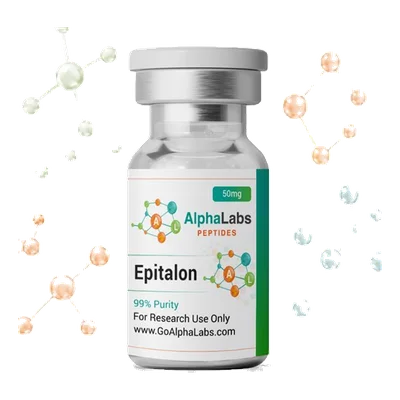
Epitalon is a synthetic tetrapeptide, Ala-Glu-Asp-Gly, designed from a bovine pineal gland extract studied by Vladimir Khavinson's group in St. Petersburg; it isn't an approved drug in the US. In July 2026 an FDA advisory committee voted 7-4 to recommend letting pharmacies compound it, but that vote is non-binding and hasn't changed its status. Most Epitalon research is in cells and animals.
Notice: Research peptides are sold for in-vitro laboratory research only. They are not FDA-approved, not for human or animal consumption, and this page is not medical advice. It contains no dosing or use guidance.
What Epitalon is
Epitalon (also spelled Epithalon, or written AEDG) is four amino acids: alanine, glutamic acid, aspartic acid and glycine, joined in that order.
According to a 2025 review in the International Journal of Molecular Sciences, it was synthesized based on the amino acid composition of Epithalamin, an extract of bovine pineal gland. The review credits V.K. Khavinson and V.N. Anisimov with leading the work on the extract's activity. Epitalon belongs to the family of short "bioregulator" peptides from that group, alongside pinealon, which is a different, three-residue peptide (see best pinealon vendors for the contrast).
What the research covers
The 2025 review (Araj, Brzezik, Mądra-Gackowska and Szeleszczuk) is the most complete recent summary. It sorts the evidence like this:
| Evidence type | Examples cited in the review |
|---|---|
| In vitro | Rat pinealocytes, HeLa cells, human fibroblasts, stem cells, neuroblastoma and immune cell lines; effects on telomerase, antioxidant enzymes and melatonin-related signaling |
| In silico | Docking and molecular dynamics models of interactions with DNA and histones |
| Animal | Fruit flies, mice, rats (the most common model), rhesus monkeys and rabbits |
| Human | A trial in 162 patients with retinitis pigmentosa, a study of 75 women measuring melatonin and circadian gene markers, and ex vivo work on donor lymphocytes |
Much of the literature comes from the same research network, and independent replication is limited. The review itself is cautious on three points:
- Mechanism: "its mechanism of action remains unclear."
- Characterization: "the number of physico-chemical and structural works on this peptide are very limited."
- Safety: it calls for short- and long-term toxicity, genotoxicity and carcinogenicity studies before approval as a new active ingredient.
None of this establishes an effect on aging or any disease in people.
The July 2026 FDA advisory vote
Epitalon became a regulatory story in 2026 because of pharmacy compounding, not because of any drug approval.
| Date | Event | Source |
|---|---|---|
| Apr 22, 2026 | FDA's Category 2 page lists Epitalon among nominations "withdrawn by the nominators," noting FDA "has not identified safety-related information regarding epitalon for the proposed route of administration" | FDA |
| Jul 24, 2026 | The Pharmacy Compounding Advisory Committee reviews "Epitalon (free base)/ Epitalon acetate" for insomnia, the nominated use | FDA meeting page |
| Jul 24, 2026 | The committee votes 7 yes, 4 no, 1 abstaining to recommend Epitalon for the 503A bulks list; FDA staff had recommended against inclusion | McDermott Will & Schulte |
| Aug 18, 2026 | Law firm analysis notes the votes "did not amend the 503A Bulks List"; FDA would need a proposed rule, comments and a final rule | Buchanan Ingersoll & Rooney |
| Oct 14, 2026 | FDA submits an "Interim Access Policy for Compounding Using Certain Peptides" to the White House Office of Information and Regulatory Affairs; text and covered peptides not public | Buchanan Ingersoll & Rooney, Oct 16, 2026 |
Epitalon was one of six peptides the committee recommended over the two days, along with BPC-157, KPV, TB-500, MOTs-C and Semax; emideltide (DSIP) wasn't recommended.
Three points are easy to miss:
- FDA's meeting page says "Advisory committees make non-binding recommendations to the FDA."
- Even a final rule would cover licensed pharmacy compounding under a prescription, not online "research use only" sales.
- As of October 21, 2026, we found no published FDA decision adding Epitalon to the 503A list, and the interim policy's terms weren't public.
We track updates in peptide regulatory news and explain the framework in FDA peptide regulation in 2026.
Other agencies
- FDA enforcement: FDA's 2020 warning letter to Tailor Made Compounding listed Epitalon among bulk substances that weren't eligible for compounding at the time.
- WADA: the 2026 Prohibited List doesn't name Epitalon (WADA; 2026 list text). Its S0 section covers "any pharmacological substance which is not addressed by any of the subsequent sections" and has no current approval for human therapeutic use.
- DEA: not on DEA's controlled substances list dated August 27, 2026.
More: are peptides legal?
Research-grade vials: what the market looks like
As of October 21, 2026, 73 vendors in our Epitalon price index had it in stock, at a median of $3.50 per mg, one of the lower medians in our index. The cheapest in-stock listings per mg are all 50 mg vials:
| Vendor | Listing | Price | $/mg | Review |
|---|---|---|---|---|
| Maximum Peptides | Epithalon 50mg | $55.00 | $1.10 | Review |
| True Research Labs | Epitalon 50mg | $59.00 | $1.18 | Review |
| Go Alpha Labs | Epitalon 50mg | $59.49 | $1.19 | Review |
Prices are as listed on vendors' sites on October 21, 2026 and change often. We compare documentation and labs in best Epitalon vendors, and current discounts are on the Epitalon coupon code page.
How to check an Epitalon COA
- Confirm it's Epitalon, not pinealon. Epitalon is a four-residue peptide; the mass-spec result should match Ala-Glu-Asp-Gly, not the three-residue Glu-Asp-Arg.
- Check measured content. Large 50 mg vials make fill errors matter more. See peptide purity vs net content.
- Match the lot number on the certificate to the vial, and look for a recent test date.
- Know what you're buying. Oral "bioregulator" capsules and lyophilized research vials are different products.
- Verify the lab. Use our COA guide and COA checklist.
Bottom line
Epitalon is a small synthetic peptide with a long research history, most of it from one group and most of it preclinical. The July 2026 FDA advisory vote was a step toward possible pharmacy compounding, not an approval, and as of October 21, 2026 FDA hadn't acted on it. Research-labeled Epitalon remains an unapproved chemical.
Sources are linked inline and were checked October 21, 2026.