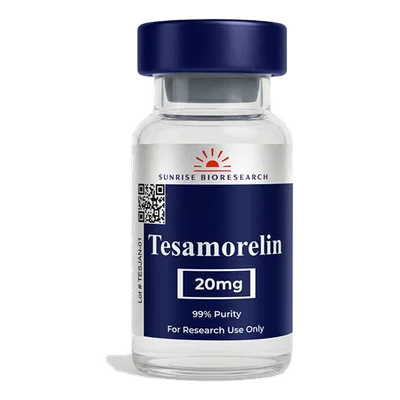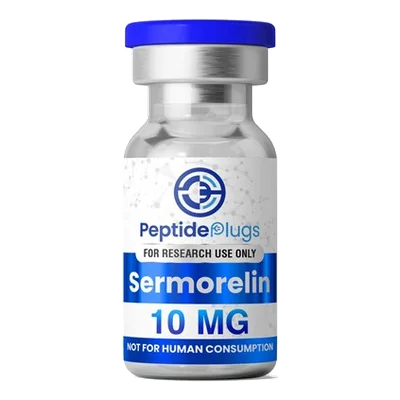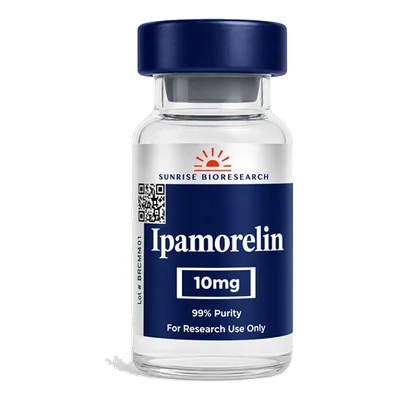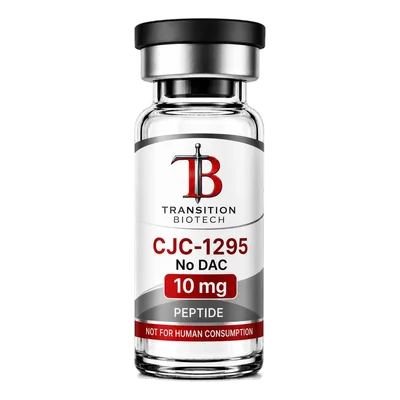
Sermorelin is a synthetic peptide made of the first 29 amino acids of human growth hormone-releasing hormone (GHRH), the part that carries the hormone's activity. Unlike most research peptides, it was once FDA-approved: it was sold as Geref by EMD Serono until the company stopped selling it, and FDA withdrew the approvals effective June 18, 2009. As of October 21, 2026, no sermorelin product is approved in the US.
Notice: Research peptides are sold for in-vitro laboratory research only. They are not FDA-approved, not for human or animal consumption, and this page is not medical advice. It contains no dosing or use guidance.
What sermorelin is
Natural GHRH is a 44-amino-acid hormone made in the hypothalamus. It signals the pituitary to release growth hormone. Researchers found that a shorter piece keeps that activity. The National Library of Medicine's MeSH entry describes sermorelin as "the biologically active fragment of human growth hormone-releasing factor, consisting of GHRH(1-29)-amide" (MeSH D017337). MeSH adds that it's used to diagnose or treat growth hormone deficiency.
Sermorelin works through the GHRH receptor. That's a different route from ipamorelin and other ghrelin-receptor agonists (ipamorelin vs sermorelin). CJC-1295 and tesamorelin are modified GHRH analogs built to last longer (CJC-1295 vs sermorelin; tesamorelin vs sermorelin).
The Geref approval history
FDA's 2013 Federal Register notice lays out the record (FDA, published March 4, 2013):
| Product | Application | Approved | Holder |
|---|---|---|---|
| Geref (sermorelin acetate) injection, diagnostic ampule | NDA 19-863 | December 28, 1990 | EMD Serono |
| Geref (sermorelin acetate) injection, vials | NDA 20-443 | September 26, 1997 | EMD Serono |
The 1990 product was a diagnostic agent, used to test the pituitary's growth hormone response. The 1997 product was approved for treating children with growth hormone deficiency, according to secondary references summarizing the label; we couldn't open an archived FDA label to quote it.
Discontinuation and withdrawal
- Discontinued by the maker. EMD Serono asked FDA to withdraw NDA 20-443 because the product "was being discontinued." FDA withdrew approval of both NDAs effective June 18, 2009 (FDA).
- Not for safety or effectiveness. In the same notice, FDA determined the Geref products "were not withdrawn for reasons of safety or effectiveness." That means they stay on the Orange Book's discontinued list and a generic application referencing them could, in principle, be approved if it met the other requirements.
No one has brought an approved sermorelin product back to the US market as of October 21, 2026, as far as we found.
What the evidence covers
Sermorelin's clinical record is older and narrower than many people assume. It rests on the studies FDA reviewed for Geref's diagnostic use and for treating children with growth hormone deficiency in the 1990s, summarized in a 1999 BioDrugs review of its use in diagnosis and treatment of children with idiopathic growth hormone deficiency. Recombinant growth hormone became the standard treatment for that condition.
The published record for adults, aging or body composition is much thinner than the pediatric data behind Geref, and we found no large modern trial. Approval for a pediatric indication doesn't establish benefit for other uses.
Compounding and regulatory status (October 2026)
- No current approval. Geref's approvals were withdrawn in 2009. Research-labeled sermorelin from peptide vendors isn't Geref and isn't an approved drug.
- Not on FDA's risk lists. Sermorelin doesn't appear on FDA's Category 2 page (content current as of April 22, 2026) or in FDA's 503A bulk drug substance categories list updated May 14, 2026.
- Compounding rules. Section 503A lets licensed pharmacies compound from bulk substances that have a USP monograph, are components of FDA-approved drugs, or appear on FDA's 503A bulks list (21 U.S.C. 353a). We couldn't find an FDA statement that directly addresses how sermorelin, a component of a drug whose approval was withdrawn for non-safety reasons, fits those criteria. We don't guess at it here.
- Advisory reviews. Sermorelin wasn't among the seven peptides at FDA's July 2026 compounding advisory meeting, or the five expected at the next meeting by February 2027 (Holland & Knight, October 2026).
- "Research" sales. FDA's 2026 warning letters treat research-labeled peptides as unapproved new drugs when a seller's marketing shows human use. See FDA peptide regulation in 2026.
- WADA. The 2026 Prohibited List names sermorelin under S2.2.4, "growth hormone-releasing hormone (GHRH) and its analogues," prohibited at all times.
Research-grade vials: what the market looks like
As listed on vendors' sites on October 21, 2026, 64 vendors in our price index had sermorelin in stock, at a median of $8.00 per mg. Prices change often. Current listings are on our sermorelin price page, and our vendor comparison is at best sermorelin vendors.
How to check a sermorelin COA
Sermorelin is a 29-amino-acid peptide, long enough that truncated or modified sequences are possible. Use our COA guide or the COA checklist and look for:
- Identity by mass spectrometry, with a mass that matches sermorelin, not a related GHRH analog such as CJC-1295 or "Mod GRF 1-29."
- Measured net content against the label (purity vs net content).
- A lot number matching your vial and a recent test date.
- An endotoxin result, if offered (endotoxin testing).
- A lab you can verify, and any independent results for the vendor (what is Finnrick?).
Summary
Sermorelin is GHRH(1-29), the active fragment of growth hormone-releasing hormone. FDA approved it as Geref in 1990 and 1997 and withdrew those approvals in 2009 after EMD Serono discontinued it, later confirming the withdrawal wasn't for safety or effectiveness. Today there's no approved product, WADA bans it, and research-labeled vials aren't the former drug.
Sources are linked inline and were checked October 21, 2026.