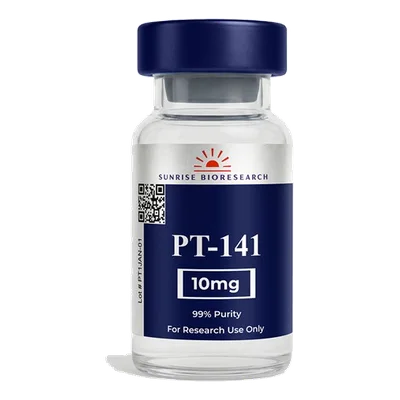
Hexarelin (examorelin) is a synthetic six-amino-acid growth hormone-releasing peptide, studied mainly in Italy in the 1990s and early 2000s, including for a direct effect on heart muscle. It was never approved as a drug. As of October 21, 2026 it isn't on any FDA compounding list, and WADA bans it in sport at all times. We added hexarelin to our price index on October 21, 2026, with 26 vendors in stock.
Notice: Research peptides are sold for in-vitro laboratory research only. They are not FDA-approved, not for human or animal consumption, and this page is not medical advice. It contains no dosing or use guidance.
The molecule
Hexarelin is a hexapeptide with the sequence His-D-2-methyl-Trp-Ala-Trp-D-Phe-Lys-NH2, molecular formula C47H58N12O6 and molecular weight of about 887 (GenScript catalog entry). WADA lists it under its international nonproprietary name, examorelin.
It belongs to the growth hormone-releasing peptide (GHRP) family, alongside GHRP-2, GHRP-6 and ipamorelin. These synthetic peptides act at the growth hormone secretagogue receptor, the same receptor the hormone ghrelin uses. A 2014 review in the Journal of Geriatric Cardiology describes hexarelin as more chemically stable and more potent than ghrelin, and says it also binds CD36, a receptor in heart tissue that may mediate its cardiac effects.
The cardiac research
What sets hexarelin apart from other GHRPs is a series of small human studies, mostly by Ezio Ghigo's group in Turin, testing whether it acts on the heart directly rather than through growth hormone (GH).
| Study | Who was studied | What was reported |
|---|---|---|
| Bisi et al., European Journal of Pharmacology, 1999 | 7 men with GH deficiency and 9 healthy men | Ejection fraction rose in both groups, even though GH barely rose in the GH-deficient men. Authors described "a short-lasting positive inotropic effect in humans." |
| Broglio et al., European Journal of Pharmacology, 2002 | 24 men with coronary artery disease during bypass surgery | Ejection fraction and cardiac output rose and wedge pressure fell. Placebo, GHRH and recombinant GH had no comparable effect. |
| Imazio et al., European Journal of Heart Failure, 2002 | 8 patients with dilated and 5 with ischemic cardiomyopathy | Ejection fraction rose in ischemic cardiomyopathy but not in dilated cardiomyopathy. |
These were acute, single-session studies in small groups. They measured short-term changes in heart function, not long-term outcomes like survival or hospital admissions. Animal work since then, summarized in the 2014 review, has explored the CD36 pathway, and the review's authors called hexarelin a possible "promising therapeutic agent." We found no large or recent controlled trial, and no company has taken hexarelin through to approval.
Regulatory status (October 2026)
- FDA: not approved. We found no FDA-approved product containing hexarelin.
- Not on FDA's compounding lists. Hexarelin doesn't appear on FDA's Category 2 page (April 22, 2026) or the 503A categories list (May 14, 2026), so it hasn't been nominated for pharmacy compounding as far as those lists show. By contrast, GHRP-2, GHRP-6 and ipamorelin acetate are in Category 2 for 503B outsourcing facilities.
- One FDA letter mentions it. FDA's December 8, 2025 warning letter to Darmerica, LLC, a Florida drug ingredient firm, says its drug listing for "Hexarelin Acetate" gave the active ingredient as "peptide B27PD." FDA treated the listing as misbranding. Hexarelin wasn't named in the 2026 peptide-seller warning letters we checked.
- Research labels don't protect sellers. FDA treats "research use only" peptides as unapproved new drugs when a seller's site shows human use (FDA peptide regulation in 2026; are peptides legal?).
- WADA: banned at all times. The 2026 Prohibited List names "examorelin (hexarelin)" among GH-releasing peptides under S2.2.4 (list text). USADA's 2027 list advisory says GHRPs remain under S2 from January 1, 2027.
- DEA: we found no federal scheduling action for hexarelin.
Research-grade vials: what the market looks like
Hexarelin is new to our index as of October 21, 2026. 26 vendors in our hexarelin price index had it in stock, with a median of $9.80 per mg, against $4.00 for GHRP-2 and GHRP-6 and $6.30 for ipamorelin. The lowest per-mg listings:
| Vendor | Listing | Price | $/mg |
|---|---|---|---|
| Bulk Peptide Supply | Hexarelin 5mg | $27.50 | $5.50 |
| Elite Peptides | Hexarelin 5mg | $28.99 | $5.80 |
| PSPeptides | Hexarelin 10mg | $59.99 | $6.00 |
Prices are as listed on vendors' sites on October 21, 2026 and change often. Related GHRPs have their own price pages: GHRP-2, GHRP-6 and ipamorelin (vendors compared in best ipamorelin vendors). We don't have a hexarelin vendor ranking yet.
How to check a hexarelin COA
- Identity by mass spectrometry. The result should match hexarelin's mass of about 887. GHRP-2 and GHRP-6 are similar-sized hexapeptides, so purity alone won't tell them apart (HPLC purity explained).
- Measured content vs the label. Small 5 mg vials leave little margin for underfill (purity vs net content).
- A lot number matching the vial, a recent test date and a named lab you can verify.
- Salt form. Hexarelin is often supplied as an acetate; the TFA vs acetate guide explains why that changes the weighed amount.
More: how to read a peptide COA and the COA checklist.
Bottom line
Hexarelin is an older synthetic GHRP with a small but real human research record, mainly short-term studies suggesting a direct effect on heart contraction. That work never led to an approved drug. It isn't on any FDA compounding list, it's banned in sport, and research vials carry a higher median price per mg than GHRP-2, GHRP-6 or ipamorelin in our index.
Sources are linked inline and were checked October 21, 2026.