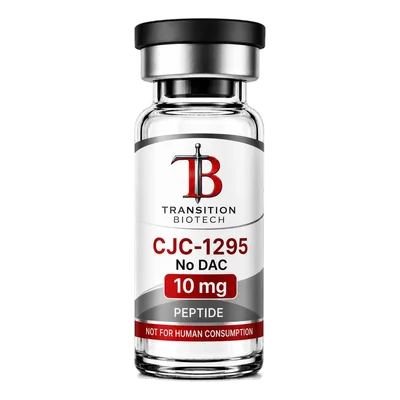
CJC-1295 is a modified analog of growth hormone-releasing hormone (GHRH) that Canadian biotech ConjuChem designed to bind albumin in the blood so it would last for days instead of minutes; it was never approved, and its development stopped after a participant died in a 2006 trial. "CJC-1295 without DAC," sold widely as a research peptide, is a different molecule: Modified GRF(1-29). FDA's compounding advisers voted against compounding CJC-1295 in December 2024, and WADA bans it at all times.
Notice: Research peptides are sold for in-vitro laboratory research only. They are not FDA-approved, not for human or animal consumption, and this page is not medical advice. It contains no dosing or use guidance.
What CJC-1295 is
GHRH is a 44-amino-acid hormone, and its first 29 amino acids, GRF(1-29), are the fragment most analogs are built on. Unmodified GRF(1-29) is short-lived in the body; one route of breakdown is the enzyme dipeptidyl peptidase-IV, which the CJC-1295 paper specifically tested against.
ConjuChem's scientists introduced CJC-1295 in a July 2005 Endocrinology paper. They describe it as "a tetrasubstituted form of hGRF1–29" with an added maleimide-bearing lysine at the C-terminus. In plain terms:
- Four substitutions in GRF(1-29): D-alanine at position 2, glutamine at 8, alanine at 15 and leucine at 27, intended to make the peptide more stable.
- An added lysine at position 30 carrying a maleimide group, the reactive part of ConjuChem's "Drug Affinity Complex" (DAC).
- Albumin binding: the maleimide bonds to a free cysteine on serum albumin, so the peptide rides on albumin and stays in circulation.
In rats, CJC-1295 remained in plasma beyond 72 hours, and the authors called it "a stable and active hGRF1–29 analog with an extended plasma half-life."
With DAC vs without DAC (Mod GRF 1-29)
This is the most common point of confusion with CJC-1295, and it matters for any certificate.
| CJC-1295 "with DAC" | "CJC-1295 without DAC" (Mod GRF 1-29) | |
|---|---|---|
| Structure | Four-substituted GRF(1-29) + maleimide-lysine (DAC) | Four-substituted GRF(1-29), no DAC |
| Binds albumin | Yes, by design | No |
| Human half-life data | Estimated 5.8 to 8.1 days (Teichman et al., 2006) | No comparable published trial of the product as sold |
| Developer | ConjuChem | Not a ConjuChem product; a research-market name |
Because they're different molecules with different masses, a certificate for one doesn't document the other. Vendors often list the no-DAC version under the CJC-1295 name, sometimes with "Mod GRF 1-29" in brackets. Sermorelin, by contrast, is unmodified GRF(1-29); we compare all three in CJC-1295 vs sermorelin.
ConjuChem's clinical program
The 2006 healthy-volunteer study
ConjuChem tested CJC-1295 in two randomized, placebo-controlled, double-blind trials in healthy adults aged 21 to 61, published in the Journal of Clinical Endocrinology & Metabolism (Teichman et al., 2006; DOI 10.1210/jc.2005-1536). The authors reported:
- Mean plasma GH rose 2- to 10-fold, staying elevated for 6 days or more.
- Mean plasma IGF-1 rose 1.5- to 3-fold, staying elevated for roughly 9 to 11 days.
- An estimated half-life of 5.8 to 8.1 days.
- No serious adverse reactions in those studies.
The halted phase 2 trial
ConjuChem then ran a phase 2 trial in people with HIV-associated visceral obesity: 192 participants across North and South America. On July 17, 2006, the company stopped the study after a participant died (aidsmap, July 31, 2006). At the time of that report, the cause of death and any link to CJC-1295 were still under investigation. CJC-1295 didn't reach approval. A different GHRH analog in the same indication, Theratechnologies' tesamorelin, went on to FDA approval in 2010 as Egrifta.
FDA status (October 2026)
CJC-1295 has never been an FDA-approved drug. Its compounding status was settled in 2024:
| Date | Event | Source |
|---|---|---|
| Apr 1, 2020 | FDA warning letter to Tailor Made Compounding notes CJC 1295 had "not been nominated for inclusion on the 503A bulks list" | FDA |
| Sept 2024 | FDA removes CJC-1295 from Category 2 after the nominator withdrew it | Reed Smith summary |
| Dec 4, 2024 | Pharmacy Compounding Advisory Committee votes against all five CJC-1295 forms, including 0-13 for CJC-1295 free base and 0-13 for CJC-1295 DAC free base | FDA final summary minutes |
| Apr 22, 2026 | FDA's Category 2 page lists CJC-1295 among nominations "withdrawn by the nominators" | FDA |
FDA's Category 2 page states: "FDA has identified serious adverse events associated with CJC-1295 including increased heart rate." CJC-1295 wasn't among the peptides on the July 2026 advisory committee agenda. FDA's position on "research use only" labels is covered in FDA peptide regulation in 2026.
Other agencies
- WADA: the 2026 Prohibited List names CJC-1295 under S2.2.4, "growth hormone-releasing hormone (GHRH) and its analogues," prohibited at all times (WADA; 2026 list text).
- DEA: not on DEA's controlled substances list dated August 27, 2026.
More: are peptides legal?
Research-grade vials: what the market looks like
As of October 21, 2026, 53 vendors in our CJC-1295 price index had it in stock, at a median of $7.80 per mg. All three of the cheapest in-stock listings per mg are the no-DAC version:
| Vendor | Listing | Price | $/mg | Review |
|---|---|---|---|---|
| Bulk Peptide Supply | CJC-1295 NO DAC 10mg | $25.00 | $2.50 | Review |
| Geo Peptides | CJC-1295 no DAC (Mod GRF 1-29) 10mg | $42.99 | $4.30 | Review |
| Transition Biotech | CJC-1295 No DAC 10mg | $44.99 | $4.50 | Review |
Prices are as listed on vendors' sites on October 21, 2026 and change often. Blends are tracked separately on our CJC-1295 + ipamorelin price page. We compare documentation and labs in best CJC-1295 vendors.
How to check a CJC-1295 COA
- Confirm which molecule was tested. The certificate should say "with DAC" or "without DAC / Mod GRF 1-29," and the mass-spec result should match that version. The DAC version is heavier because of the maleimide-lysine.
- Match the name to your vial. A "CJC-1295" label on a no-DAC product is common; a no-DAC certificate won't document a DAC vial, or the reverse.
- Check measured content, not just purity. See peptide purity vs net content.
- Match the lot number and look for a recent test date.
- Verify the lab. Use our COA guide and COA checklist.
Bottom line
CJC-1295 was a serious drug candidate whose development ended in 2006. The original molecule binds albumin; most of what's sold today under its name is the shorter-lived Mod GRF(1-29). Neither is approved, FDA's advisers voted against compounding CJC-1295 in 2024, and WADA bans it. If you're comparing research suppliers, start by confirming which molecule a certificate actually covers.
Sources are linked inline and were checked October 21, 2026.