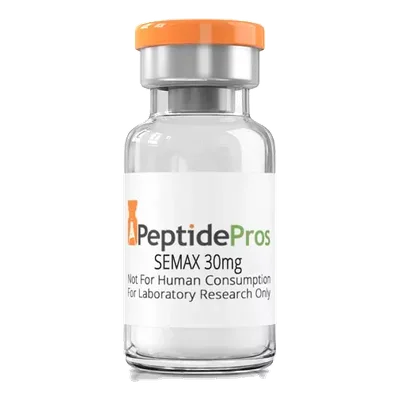
Semax is a synthetic seven-amino-acid peptide, Met-Glu-His-Phe-Pro-Gly-Pro, developed in Russia as an analog of the ACTH(4-10) fragment of adrenocorticotropic hormone. It's registered as a nasal-drop drug in Russia but isn't approved in the US. In July 2026, FDA's compounding advisers voted to recommend it for pharmacy compounding, and as of October 21, 2026 FDA hadn't acted on that vote.
Notice: Research peptides are sold for in-vitro laboratory research only. They are not FDA-approved, not for human or animal consumption, and this page is not medical advice. It contains no dosing or use guidance.
What semax is made of
Semax takes the first four amino acids of the ACTH(4-10) fragment (Met-Glu-His-Phe) and adds a Pro-Gly-Pro tail. That tail is meant to slow breakdown. The Russian drug reference RLS lists the active substance as "methionyl-glutamyl-histidyl-phenylalanyl-prolyl-glycyl-proline" (RLS registration record).
A 2022 review from the Pavlov Institute of Physiology describes semax as a "synthetic analogue of ACTH4–10" and says it's used clinically in Russia as a nootropic and neuroprotective agent, mainly for cerebral circulation disorders (Zhuikova, Integrative Physiology, 2022). Semax and its sister peptide selank came out of the same Russian research program; we compare them in semax vs selank.
Registration in Russia
Semax is a registered medicine in Russia, which is unusual for a peptide sold in the US gray market. According to RLS, registration certificate Р N000812/01 was issued on December 29, 2011, is valid indefinitely, and is held by PEPTOGEN, a Russian company. The registered form is a 1% nasal drop (RLS).
Secondary sources often say semax is on Russia's List of Vital and Essential Drugs. We couldn't confirm that from an official list, so we don't rely on it here.
Russian registration doesn't carry over to the US. FDA hasn't reviewed semax as a drug, and research-labeled vials sold online aren't the Russian product.
What the published evidence shows
Most semax research comes from Russian groups. It falls into two buckets.
Animal and cell studies
The bulk of the literature is in rats, especially models of cerebral ischemia (blocked blood flow to the brain). These studies look at gene expression, neurotrophins such as BDNF, immune and vascular genes, and behavior. Examples:
- Neurotrophin genes after ischemia: semax and its Pro-Gly-Pro fragment were reported to activate transcription of neurotrophins and their receptor genes after cerebral ischemia (Cell Mol Neurobiol, 2010).
- Immune and vascular genes: a genome-wide study in rat focal ischemia reported changes in immune and vascular gene expression (BMC Genomics, 2014).
The 2022 review notes that many of its cited studies are in rodents, across models from ischemia to gastric ulcers, and that the mechanisms are still being studied (Zhuikova, 2022).
Human studies
Clinical work is small and almost entirely Russian:
| Study | Population | What it measured | Reported finding |
|---|---|---|---|
| Gusev et al., 1997 | 30 patients on semax, 80 controls, acute hemispheric ischemic stroke | Neurological rating scales, EEG mapping, evoked potentials | Authors said semax "had some influence on the rate of restoration" of function |
| Gusev et al., 2018 | 110 patients after ischemic stroke, early vs late rehabilitation | Plasma BDNF, motor scores, Barthel index | Authors reported higher BDNF and faster recovery with early rehabilitation plus semax |
Neither abstract describes a large, blinded, multicenter trial. The 1997 study compared semax against conventional therapy, and the 2018 abstract doesn't state randomization. That's a long way from the evidence FDA requires for approval.
Bottom line on evidence: semax has decades of Russian animal research and a handful of small clinical studies, mostly in stroke. We found no large randomized trial run outside Russia.
US regulatory status (October 2026)
- Not approved. Semax isn't an FDA-approved drug.
- Category 2: FDA's list of bulk substances that may present significant safety risks (content current as of April 22, 2026) puts "semax (heptapeptide)" in the table of nominations withdrawn by the nominators. FDA's note says it "has no, or limited, safety-related information for proposed routes of administration." Leaving Category 2 isn't an approval.
- July 2026 advisory vote: on July 24, 2026, FDA's Pharmacy Compounding Advisory Committee voted 8 yes, 5 no, 1 abstaining to recommend semax for the 503A bulks list, the list of substances licensed pharmacies may compound from (RAPS). FDA staff had recommended against it, and the vote is non-binding (Holland & Knight, October 2026).
- Pending interim policy: on October 14, 2026, HHS and FDA sent an "Interim Access Policy for Compounding Using Certain Peptides" to the White House Office of Management and Budget. Its OMB status was "Pending EO 12866 Regulatory Review" when we checked (Reginfo.gov). The text isn't public, so we can't say which peptides it covers.
- WADA: the 2026 Prohibited List doesn't name semax. Its S0 section covers substances "with no current approval by any governmental regulatory health authority for human therapeutic use."
None of this applies to research-chemical sales. A compounding pathway would cover licensed pharmacies filling prescriptions, not vendors selling "research use only" vials. See FDA peptide regulation in 2026 and are peptides legal?
Research-grade vials: what the market looks like
As listed on vendors' sites on October 21, 2026, 73 vendors in our price index had semax in stock, at a median of $4.50 per mg. Prices change often, and vial sizes vary, so compare per mg. Current listings are on our semax price page, and our vendor comparison is at best semax vendors.
How to check a semax COA
Semax is cheap to make, which means price alone tells you little. Use our COA guide or the COA checklist, and look for:
- Identity by mass spectrometry. The measured mass should match semax, not a related peptide.
- The exact molecule. "N-Acetyl Semax" and "NA-Semax-Amidate" are vendor-modified derivatives with different masses. They aren't the Russian-registered molecule, and their COAs should show the modified mass.
- Measured net content against the label, not just HPLC purity (purity vs net content).
- A lot number matching your vial and a recent test date.
- A lab you can verify, such as a Janoshik report with a verification key (how to verify a Janoshik report).
Summary
Semax is a Russian ACTH(4-10) analog with a real registration history at home and a thin, mostly Russian evidence base. In the US it isn't approved. A July 2026 advisory vote favored allowing pharmacy compounding, but FDA hadn't acted on it as of October 21, 2026, and none of that changes the status of research-labeled vials.
Sources are linked inline and were checked October 21, 2026. We'll update this page when FDA acts on the July 2026 vote or publishes its interim peptide policy.