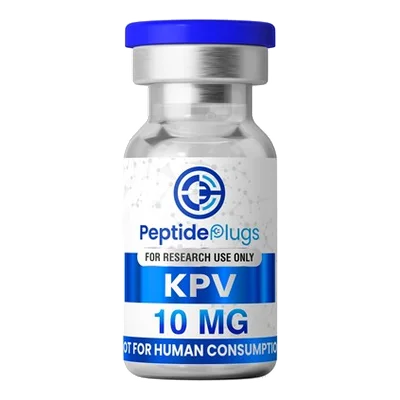
KPV is the tripeptide lysine-proline-valine, the last three amino acids of alpha-melanocyte-stimulating hormone (alpha-MSH), studied for anti-inflammatory effects in cells and mice. It has no published controlled human trials and isn't an approved drug. In July 2026, FDA's compounding advisers voted narrowly to recommend it for pharmacy compounding; as of October 21, 2026, FDA hadn't acted on that vote.
Notice: Research peptides are sold for in-vitro laboratory research only. They are not FDA-approved, not for human or animal consumption, and this page is not medical advice. It contains no dosing or use guidance.
Where KPV comes from
Alpha-MSH is a 13-amino-acid hormone made from the same precursor as ACTH. It's known for its role in skin pigmentation and also has anti-inflammatory activity. Researchers found that its C-terminal end, Lys-Pro-Val, kept some of that anti-inflammatory activity on its own.
A 2008 Endocrine Reviews paper by Brzoska and colleagues covers alpha-MSH "and related tripeptides," including KPV (Endocr Rev, 2008). KPV is small: three amino acids, a molecular formula of C16H30N4O4 and a mass of about 342 g/mol (PubChem CID 125672).
One point that matters for research: KPV doesn't seem to act only through the melanocortin-1 receptor (MC1R), which alpha-MSH uses. A mouse study found its effects "seem to be at least partially independent of MC1R signaling" (Kannengiesser et al., Inflamm Bowel Dis, 2008).
What the published evidence shows
All the key KPV studies are preclinical: cell cultures and mice.
| Study | Model | Reported finding |
|---|---|---|
| Kannengiesser et al., Inflamm Bowel Dis, 2008 | Two mouse colitis models (DSS and T-cell transfer), plus mice lacking functional MC1R | Faster weight recovery, less colon inflammation; effects partly independent of MC1R |
| Dalmasso et al., Gastroenterology, 2008 | Intestinal epithelial cells and mouse colitis | KPV is taken into gut cells by the peptide transporter PepT1; authors reported reduced intestinal inflammation |
| Mol Ther, 2017 | Mouse ulcerative colitis | Hyaluronic acid-coated nanoparticles carrying KPV promoted mucosal healing and lowered TNF-alpha |
| Sung et al., Tissue Cell, 2025 | Human skin cells (keratinocytes) exposed to fine dust | KPV reduced cell death and inflammation markers in culture |
The Dalmasso paper is often cited because it explains how such a small peptide could act in the gut: PepT1, a transporter in intestinal cells, carries KPV inside. The 2017 nanoparticle study is a drug-delivery experiment, not a test of plain KPV.
A 2023 review in Cells places KPV within broader research on the melanocortin system in inflammatory bowel disease (Gravina et al., 2023).
Bottom line on evidence: KPV has a consistent set of mouse and cell findings, mostly in colitis. We found no published randomized human trial, and FDA says it hasn't identified any human exposure data for KPV drug products. Mouse colitis results often don't carry over to people.
US regulatory status (October 2026)
- Not approved. KPV isn't an FDA-approved drug and isn't a component of one.
- Category 2. FDA's Category 2 page (content current as of April 22, 2026) lists KPV in the table of nominations "withdrawn by the nominators," not in Category 2 itself. FDA's note says it "has not identified any human exposure data on drug products containing KPV." Leaving Category 2 isn't an approval.
- July 2026 advisory vote. FDA staff recommended against adding KPV to the 503A bulks list (Holland & Knight, October 2026). FDA's Pharmacy Compounding Advisory Committee then voted 8 yes, 6 no, 1 abstaining to recommend it (RAPS). The vote is advisory only; a substance joins the list through rulemaking.
- Pending interim policy. On October 14, 2026, HHS and FDA sent an "Interim Access Policy for Compounding Using Certain Peptides" to the White House Office of Management and Budget, where it was "Pending EO 12866 Regulatory Review" when we checked (Reginfo.gov). Its text isn't public.
- WADA. The 2026 Prohibited List doesn't name KPV. Its S0 section covers substances "with no current approval by any governmental regulatory health authority for human therapeutic use."
A compounding pathway, if FDA creates one, would cover licensed pharmacies filling prescriptions. It wouldn't change the status of research-labeled vials. More in FDA peptide regulation in 2026 and are peptides legal?
Research-grade vials: what the market looks like
As listed on vendors' sites on October 21, 2026, 72 vendors in our price index had KPV in stock, at a median of $5.50 per mg. Prices change often. Current listings are on our KPV price page, and our vendor comparison is at best KPV vendors. Some vendors also sell KPV as capsules or in blends; those aren't comparable to vials.
How to check a KPV COA
Because KPV is only three amino acids, it's easy and cheap to make. That shifts the risk to identity and fill. Use our COA guide or the COA checklist and check:
- Identity by mass spectrometry, with a mass near 342 g/mol for the free peptide. Salt forms such as acetate change the reported mass (TFA vs acetate salts).
- Measured net content, not just HPLC purity (purity vs net content).
- A lot number matching your vial and a recent test date.
- Blends broken out. A KPV blend should identify and quantify each component.
- A lab you can verify, such as a Janoshik report with a key (how to verify a Janoshik report).
Summary
KPV is the Lys-Pro-Val tail of alpha-MSH, with anti-inflammatory findings in mouse colitis and cell studies and no published human trials. It isn't approved. A July 2026 advisory vote favored allowing pharmacy compounding, but FDA hadn't acted on it as of October 21, 2026.
Sources are linked inline and were checked October 21, 2026. We'll update this page when FDA acts on the July 2026 vote or publishes its interim peptide policy.