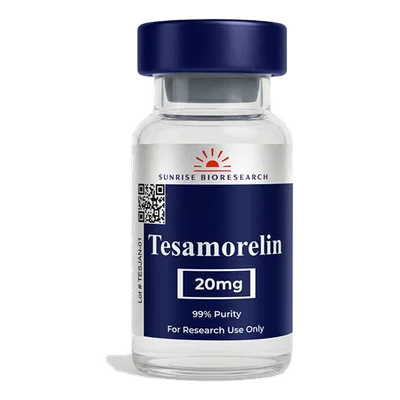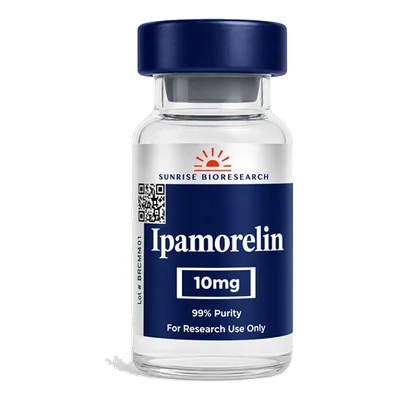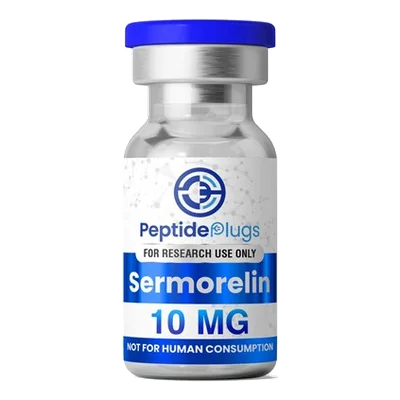
Ipamorelin is a synthetic five-amino-acid peptide that activates the ghrelin receptor and triggers growth hormone release. It was discovered at Novo Nordisk in the 1990s, failed to beat placebo in its only published phase 2 trial, and was never approved. As of October 21, 2026, FDA still lists ipamorelin acetate in Category 2, its list of compounding substances that may present significant safety risks.
Notice: Research peptides are sold for in-vitro laboratory research only. They are not FDA-approved, not for human or animal consumption, and this page is not medical advice. It contains no dosing or use guidance.
What ipamorelin is
Ipamorelin's sequence is Aib-His-D-2-Nal-D-Phe-Lys-NH2, which includes non-natural amino acids. A 1998 paper in the European Journal of Endocrinology described it as "the first selective growth hormone secretagogue." That work used rat pituitary cells, anesthetized rats and conscious pigs.
"Selective" refers to the paper's finding that ipamorelin released growth hormone without the marked rises in ACTH and cortisol seen with older secretagogues such as GHRP-6. Ipamorelin acts on the ghrelin receptor (also called GHS-R1a). That's a different route from sermorelin and CJC-1295, which act on the GHRH receptor. We compare them in ipamorelin vs sermorelin and tesamorelin vs ipamorelin.
Development history: Novo Nordisk to Helsinn
| Year | Event | Source |
|---|---|---|
| 1998 | Novo Nordisk-led paper describes ipamorelin | Eur J Endocrinol |
| 2006 | Sapphire Therapeutics licenses worldwide rights from Novo Nordisk for postoperative ileus | BioWorld, September 20, 2006 |
| 2007 | Phase 1/2 postoperative ileus studies begin in the US | AdisInsight |
| 2009 | Sapphire is acquired and merged into Helsinn | AdisInsight |
| 2011 | Helsinn starts a second phase 2 trial (HT-IPAM-202) | ClinicalTrials.gov NCT01280344 |
| 2014 | First phase 2 trial published: no significant benefit over placebo | Beck et al., Int J Colorectal Dis |
AdisInsight lists the growth-disorder indication as discontinued and gastrointestinal motility as "no development reported." Ipamorelin has never been approved by FDA or, as far as we found, any other regulator.
The postoperative ileus trials
Postoperative ileus is the temporary stall in gut movement after abdominal surgery. Ghrelin speeds gut motility, so a ghrelin agonist was a logical candidate.
The published trial (Beck, Sweeney and McCarter, 2014; ClinicalTrials.gov NCT00672074) was a multicenter, double-blind, placebo-controlled phase 2 study:
- Population: adults having small or large bowel resection; 117 enrolled, 114 analyzed.
- Primary endpoint: time to tolerating a standardized solid meal.
- Result: median 25.3 hours on ipamorelin vs 32.6 hours on placebo, not statistically significant (p = 0.15).
- Safety: treatment-emergent adverse events in 87.5% on ipamorelin vs 94.8% on placebo. The authors called it well tolerated and noted the study was small.
The second phase 2 trial, HT-IPAM-202, ran from April 2011 to May 2014 and is listed as completed. We couldn't find published results for it.
That's the extent of ipamorelin's controlled human efficacy data. Beyond these trials, the human record is mainly a small pharmacokinetic study in healthy men from 1999.
FDA status (October 2026)
- Not approved. No FDA-approved product contains ipamorelin.
- Category 2. On FDA's Category 2 page (content current as of April 22, 2026), ipamorelin acetate is one of 14 substances in the Category 2 table, alongside GHRP-2, GHRP-6, ibutamoren and kisspeptin-10. FDA notes a published report of serious adverse events, including death, after intravenous use for gastric motility. Ipamorelin also appears in the "nominated but withdrawn" table, with FDA's note that it stays in Category 2 under the 503B interim policy.
- 2024 advisory vote. At its October 29, 2024 meeting, FDA proposed that ipamorelin and ipamorelin acetate not be added to the 503A bulks list (FDA briefing document), and the Pharmacy Compounding Advisory Committee voted against adding them (A4PC).
- 2026 developments. HHS Secretary Robert F. Kennedy Jr.'s February 27, 2026 announcement named ipamorelin among peptides expected to leave Category 2 (Pharmacy Times). FDA's April 2026 page update still listed it in Category 2. Ipamorelin wasn't among the seven peptides reviewed in July 2026, or the five (GHK-Cu, LL-37, dihexa, melanotan II and PEG-MGF) expected at the next advisory meeting by February 2027 (Holland & Knight, October 2026).
- Pending policy. HHS and FDA sent an "Interim Access Policy for Compounding Using Certain Peptides" to OMB on October 14, 2026 (Reginfo.gov). Its text isn't public, so we don't know whether it covers ipamorelin.
- WADA. The 2026 Prohibited List names ipamorelin under S2.2.4, growth hormone secretagogues, prohibited at all times.
None of this makes research-labeled ipamorelin legal for human use. See FDA peptide regulation in 2026.
Research-grade vials: what the market looks like
As listed on vendors' sites on October 21, 2026, 76 vendors in our price index had ipamorelin in stock, at a median of $6.30 per mg. It's also sold in blends; those are tracked separately on the CJC-1295/ipamorelin price page. Prices change often. Single-compound listings are on our ipamorelin price page, and our vendor comparison is at best ipamorelin vendors.
How to check an ipamorelin COA
Ipamorelin is short and cheap to make, so the main risks are wrong identity and underfilled vials. Use our COA guide and check:
- Identity by mass spectrometry. Ipamorelin's non-natural residues give it a distinct mass; the COA should report it.
- Single compound vs blend. A CJC-1295/ipamorelin blend needs both components identified and quantified.
- Measured net content against the label (purity vs net content).
- A lot number matching your vial and a recent test date.
- A verifiable lab, and any independent results for the vendor (what is Finnrick?).
Summary
Ipamorelin is a Novo Nordisk-discovered ghrelin agonist whose only clinical program, for postoperative ileus, didn't show a significant benefit. It was never approved, FDA's advisers voted against compounding it in 2024, and as of October 21, 2026 it remains in Category 2.
Sources are linked inline and were checked October 21, 2026. We'll update this page if FDA moves ipamorelin out of Category 2 or schedules a new review.